
SPEECH-LANGUAGE DELAY AND /OR DISORDER
A language delay occurs when a child develops speech and language skills later than expected for their age. Children with a language delay may have difficulty understanding what others say, using words to express their ideas, or combining words into sentences. If a child is not meeting expected language milestones or has trouble communicating their needs and thoughts, speech-language therapy can help support development.
RECEPTIVE/EXPRESSIVE LANGUAGE disorders:
Children with receptive language difficulties may have trouble understanding what others say, especially when the language becomes longer or more complex. They may struggle to follow directions, understand classroom instructions, learn new vocabulary, or keep up in conversations. These challenges can make it harder for children to fully participate in learning and everyday communication.
An expressive language disorder occurs when a child has difficulty using words and sentences to express thoughts, ideas, and needs. Children may have a limited vocabulary, struggle to form sentences, or have trouble finding the right words during conversation. Speech-language therapy helps children build vocabulary, organize language, and communicate more clearly and effectively.
CHILDHOOD APRAXIA OF SPEECH (CAS):
Childhood Apraxia of Speech (CAS) is a motor speech disorder in which the brain has difficulty planning and coordinating the movements needed for speech. Children with CAS often know what they want to say, but their brains have trouble sending the correct signals to the muscles used for speaking.
Children with CAS may have delayed first words, a limited number of spoken words, inconsistent sound errors, or difficulty combining sounds into words. Speech may sound effortful or unclear, and longer or more complex words are often harder to produce. Early, specialized speech therapy can help children develop clearer and more consistent speech patterns.
ARTICULATION DISORDER:
An articulation disorder occurs when a child has difficulty producing certain speech sounds clearly. These errors often involve how the tongue, lips, teeth, or jaw are used to form sounds. Children may substitute one sound for another, distort sounds, or produce speech that is unclear or hard to understand. Speech therapy helps children learn correct sound placement and develop clearer, more accurate speech patterns.
Phonological Disorder:
A phonological disorder occurs when a child has difficulty learning and using the sound patterns of a language. Instead of occasional sound errors, the child uses consistent patterns that simplify speech, such as leaving off sounds or replacing groups of sounds with easier ones. These patterns can make speech difficult for others to understand, even though the child may be able to produce the individual sounds. Speech therapy helps children learn the correct sound patterns needed for clear and understandable speech.
FLUENCY/STUTTERING:
It is typical for all children, especially between the ages of 2 and 6, to experience periods of speech disfluency, or stuttering, as they learn to communicate. Stuttering that lasts over six months may require professional treatment and may have the following types of disfluencies:
Blocks: This occurs when they have difficulty getting a word out. They may pause for a long time or not be able to make a sound. For example, "I want a ...... snack."
Prolongations: They also may stretch a sound out for a long time, like ssssssssometimes.
Repetitions: They might repeat parts of words, like b-b-b-baby.
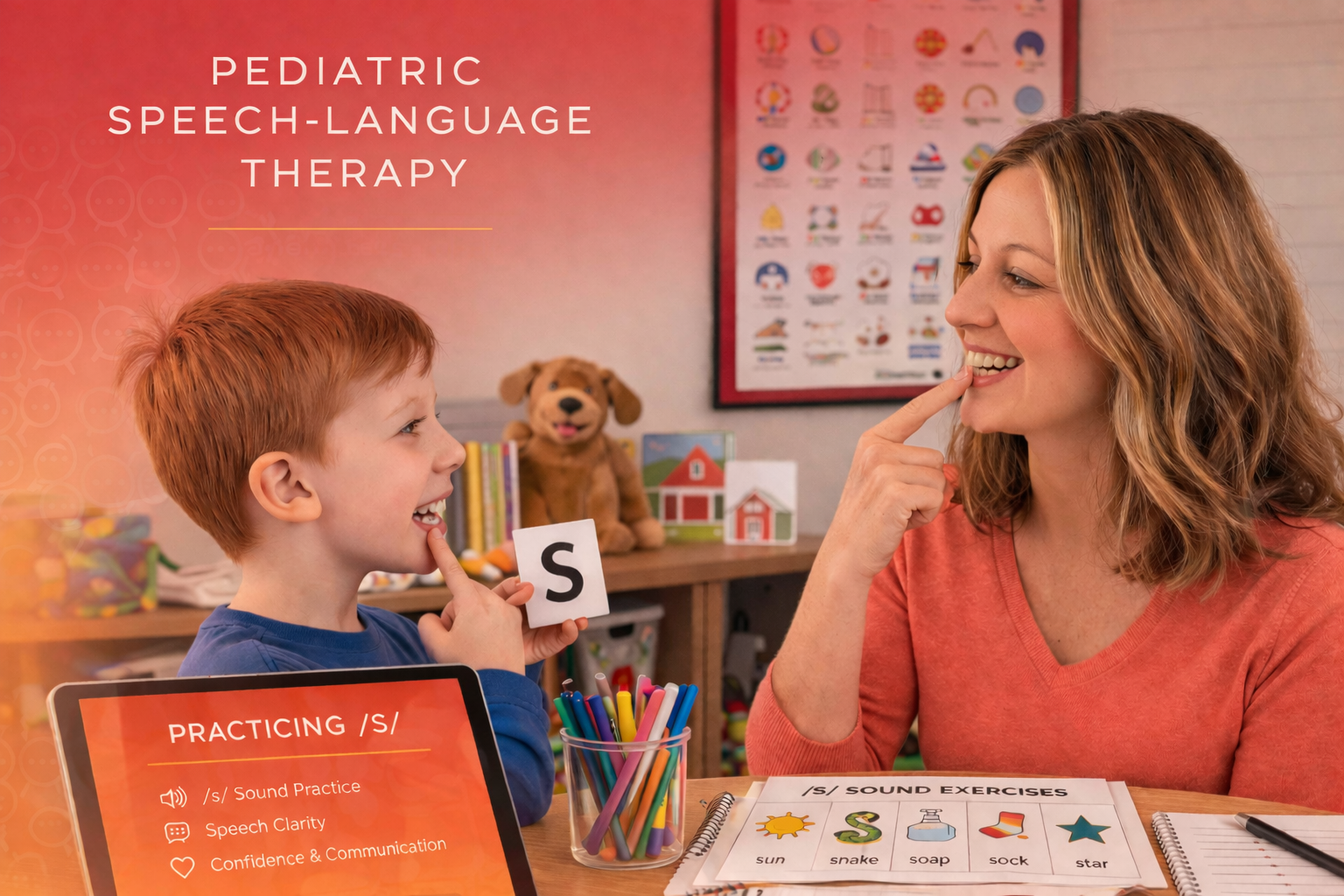
Services for children address speech and language disorders, communication challenges, and orofacial myofunctional disorders that may affect speaking, breathing, feeding, and overall oral function.

Children who have difficulty understanding or expressing speech, children with auditory processing, articulation, and social skill challenges, as well have children with trouble chewing or swallowing, can all benefit from pediatric speech therapy.